Category: Blog

Your blog category

  • How the Housing for the 21st Century Act Makes Buying a Multi-Unit Property Easier in Volusia County

    How the Housing for the 21st Century Act Makes Buying a Multi-Unit Property Easier in Volusia County

    If you are a first-time homebuyer in the Daytona Beach area, buying a multi-unit property (like a duplex or triplex) is one of the smartest ways to break into the market. Now, a new piece of federal legislation is making that strategy even more accessible.

    The newly proposed Housing for the 21st Century Act introduces several game-changing provisions for small multifamily development and investors. Here is a breakdown of what this means for first-time buyers looking to “house hack” in Volusia County.

    1. Higher FHA Loan Limits for House Hacking

    One of the biggest hurdles for first-time buyers is the down payment. Section 106 of the act updates the statutory maximum loan limits for FHA multifamily dwellings, adjusting them to reflect modern construction costs. This makes it easier for buyers of small and mid-sized buildings to secure federal financing.

    With an FHA loan, you can buy a multi-unit property with as little as 3.5% down, provided you live in one of the units for at least 12 months. You can then rent out the other units to help cover the mortgage. After the one-year mark, you are free to move out, rent the initial property in its entirety, and purchase another home.

    For context, the 2026 FHA multifamily loan limits are:

    • Two-unit (duplex): $693,050 in low-cost areas and up to $1,599,375 in high-cost areas.
    • Three-unit (triplex): $837,700 in low-cost areas and up to $1,933,200 in high-cost areas.
    • Four-unit (fourplex): $1,041,125 in low-cost areas and up to $2,402,625 in high-cost areas.

    2. Fast-Tracking “Missing Middle” Housing

    The act pushes local governments toward friendlier zoning for small multifamily units. It encourages localities to fast-track duplexes, triplexes, and quadplexes “by right,” which means they can be built without a lengthy permitting process. It also provides grants to local governments to create “pattern books” containing preapproved architectural designs for these property types to accelerate permitting.

    Additionally, the expansion of “categorical exclusions” exempts small-scale construction and infill development of residential buildings from full environmental reviews.

    3. Less Red Tape for Landlords

    For investors dealing with multiple federal funding sources, the act allows a single passed inspection to automatically meet Housing Choice Voucher (HCV) inspection requirements. This streamlined inspection process reduces the administrative headache for small landlords.

    The Bottom Line

    Increasing FHA loan limits means more people will be able to buy multifamily houses with just 3.5% down, potentially qualifying with lower credit scores than what is required for conventional mortgages.

    If you are looking to purchase your first multi-unit property in Daytona Beach or the wider Volusia County area, let’s connect. As your local eXp Realty agent, I can help you find the right property to jump-start your investing career and navigate these new financing advantages.
  • Why Waiting for a Sub-6% Mortgage Rate Could Cost You More

    Why Waiting for a Sub-6% Mortgage Rate Could Cost You More

    Many first-time homebuyers in Volusia County are currently sitting on the sidelines, waiting for that magical moment when mortgage rates dip back into the 5s. Psychologically, it feels like the smart financial move. But running the actual numbers reveals a surprising truth about what a “lower rate” really saves you in our local market.

    Let’s break down exactly what waiting for a sub-6% interest rate actually changes—and why holding out for a house in Daytona Beach or Holly Hill might end up costing you more.

    The $67 Illusion: Running the Numbers

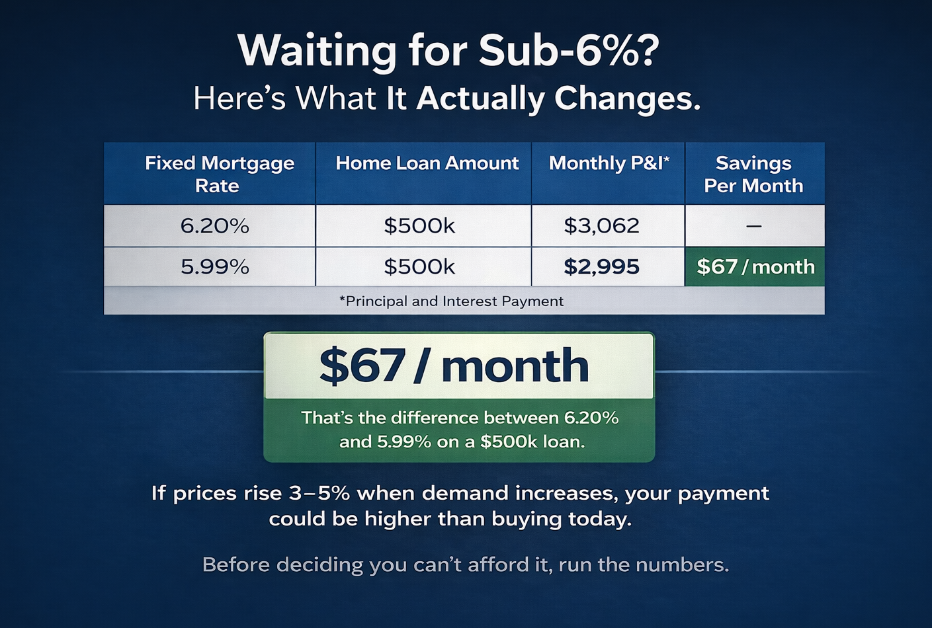
    To understand the real impact of a rate drop, let’s look at a standard $500,000 home loan. Here is how a drop from the low 6s into the high 5s impacts your monthly Principal and Interest (P&I) payment:

    • At a 6.20% Fixed Rate: Your monthly P&I is $3,062.
    • At a 5.99% Fixed Rate: Your monthly P&I drops to $2,995.

    The difference? Just $67 a month.

    While keeping an extra $67 in your pocket is always nice, it is a relatively small difference when looking at the overall cost of homeownership in Florida.

    The Real Risk: Surging Buyer Demand in Volusia County

    Here is the hidden trap of waiting for rates to drop: you are not the only one waiting. When interest rates fall below that psychological 6% threshold, a massive wave of pent-up buyer demand will re-enter the market.

    Currently, local market data shows that single-family home prices in Volusia County are cooling from recent peaks, reflecting a healthier, more balanced market rather than a downturn. Homes are taking a bit longer to sell, giving buyers more time and leverage. However, Florida is already showing early signs of a shift, with buyer activity rebounding.

    When lower rates cause demand to spike further, home prices rise. If increased competition pushes home prices up by just 3% to 5%, that same $500,000 house suddenly costs $515,000 to $525,000.

    • You might secure that shiny 5.99% rate, but you’ll be applying it to a significantly larger loan amount.
    • Because you are financing a higher purchase price, your monthly payment could actually be higher than if you had simply bought today at 6.20%.

    What This Means for the Daytona Beach Market

    In competitive coastal markets like Daytona Beach, Ormond Beach, and the surrounding Holly Hill area, waiting on the sidelines can mean missing out on the right property altogether. Getting your foot in the door and starting to build equity often outweighs the minimal monthly savings of a slightly lower rate.

    As the old real estate saying goes: Date the rate, marry the house. If rates drop significantly in the future, you always have the option to refinance. But you cannot retroactively buy a house at today’s prices or in today’s balanced market conditions.

    The Bottom Line for Florida Buyers

    Before deciding you can’t afford to buy right now, sit down and run the numbers. Making a massive financial decision based on national headlines rather than your own personal math can be an expensive mistake.

    If you are a first-time homebuyer looking to navigate the 2026 Daytona Beach real estate market, let’s connect. As your local eXp Realty expert, I can help you find a home that fits your budget today, before the next wave of buyers drives prices up.

  • Florida House Passes Historic Bill to Eliminate Property Taxes: What Homeowners Need to Know

    Florida House Passes Historic Bill to Eliminate Property Taxes: What Homeowners Need to Know

    Florida House Approves Major Property Tax Reform Proposal Heading to Voters in 2026

    The Florida House of Representatives has just passed a significant property tax reform proposal that could reshape how homeowners are taxed across the state. The bill, approved on Feb. 19, 2026, sends a proposed constitutional amendment to the ballot that would eliminate non-school property taxes on homesteaded homes and expand homestead tax exemptions — a development that could deliver meaningful tax relief for many Florida homeowners.

    What Was Just Approved?

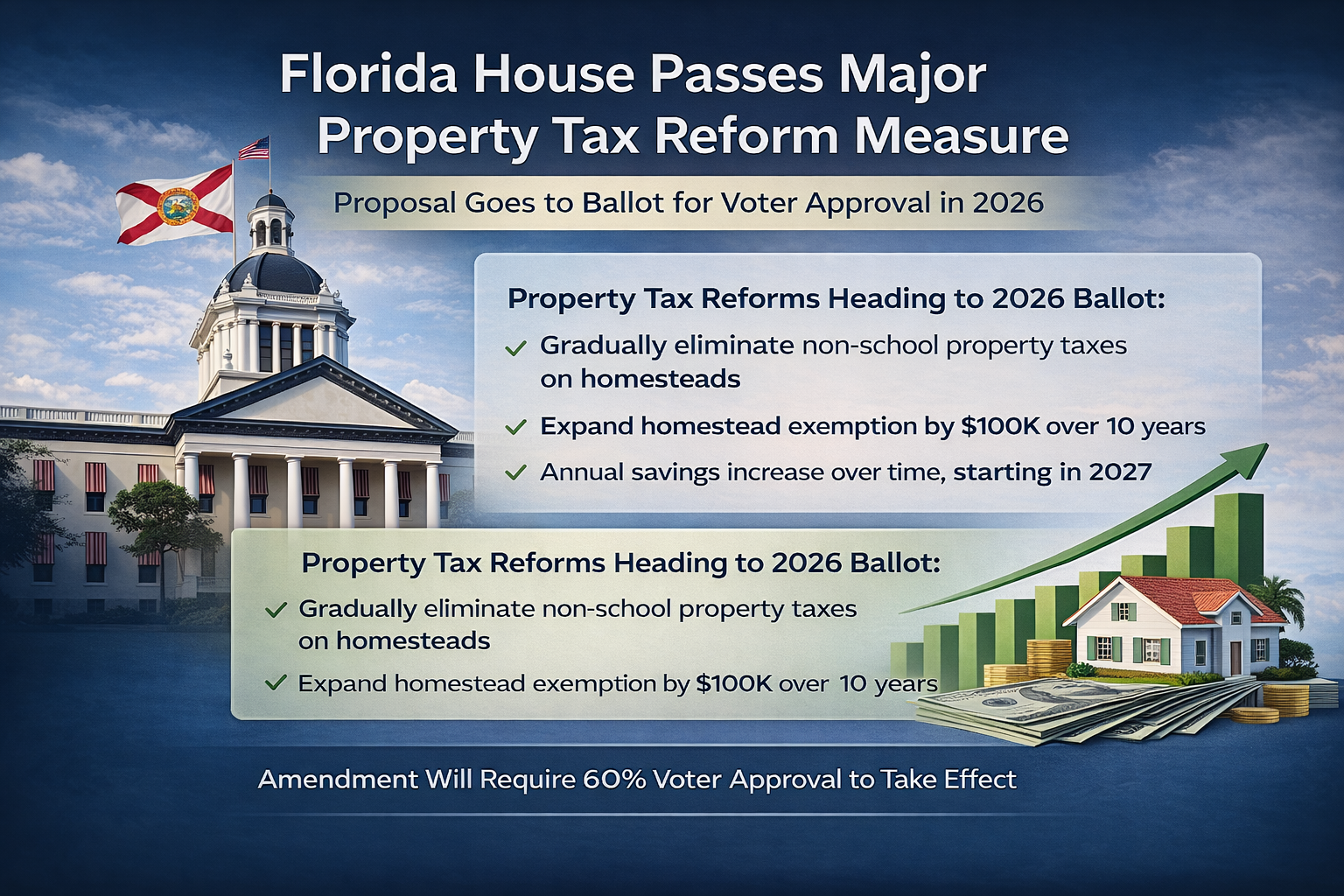
    The House passed House Joint Resolution 203 (HJR 203), which would place a constitutional amendment before Florida voters this November. If approved by at least 60% of voters (a requirement for constitutional changes in Florida), the amendment would:

    • Increase the homestead exemption for non-school property taxes by $100,000 per year over 10 years beginning in 2027.
    • Eventually eliminate non-school property taxes on homesteaded homes starting in 2037.
    • Maintain property tax levies for schools, which are not impacted by this amendment.

    In plain terms, the measure seeks to put more money back into the pockets of Florida homeowners by gradually reducing the tax burden on primary residences.

    Why This Matters to Florida Homeowners

    Property taxes are a major financial component of homeownership in Florida. They fund vital local services including:

    • Public schools
    • Fire and police departments
    • Infrastructure and road maintenance
    • Local government operations

    Eliminating or reducing non-school property taxes could significantly lower tax bills for many homeowners — particularly those on fixed incomes or long-term homesteads.

    However, this change is not yet law. First, it must be approved by Florida voters on the November 2026 ballot. Only if at least 60% of ballot participants vote “yes” would the amendment take effect.

    Where the Proposal Stands Politically

    While the House approved the resolution in a decisive vote, the proposal now faces several hurdles:

    • Uncertain Senate support: Senate leadership has not committed to moving the measure forward, meaning negotiations are likely in the final weeks of session.
    • Governor’s position: Governor Ron DeSantis has expressed support for meaningful property tax relief but has also suggested a different or more comprehensive approach, indicating he may work with the Senate on a separate plan.

    How This Could Affect You

    If this amendment becomes law:

    • Homestead property tax bills could decline annually as exemptions expand.
    • Local governments may need to adjust budgets or identify alternate revenue sources, since property tax revenue funds essential services.
    • Homeowner affordability could improve, especially for new and long-time owners alike.

    For current homeowners and prospective buyers, this development underscores the importance of staying informed about policy changes that directly impact long-term housing costs.

    What’s Next

    The proposed amendment will be debated in the Florida Senate. If it survives that legislative hurdle, it will go before voters in November 2026. Homeowners, buyers, and real estate professionals should continue monitoring both legislative and ballot progress, as the ultimate impact will hinge on voter approval in the fall.